
The test screening you paid for twice
Last updated November 16, 2026 · 20 min read

Joseph Stawiarski
Joseph builds tools for insight curation — helping teams turn scattered research into packs people actually read.
TL;DR
- Studios re-buy research they already own. Not because anyone is careless, but because studio research, from test screenings to tracking, lives in inboxes, vendor portals and the drives of people who've since left.
- Franchises make this worse. The same audience questions come back every installment, and the team asking them is rarely the team that asked last time.
- Not every repeat study is waste. Audiences change, cuts change, markets change. The goal isn't "never rerun." It's "never rerun without knowing what you already have."
- Five habits fix most of it: search by question before every brief, pull comps from your own work first, write prior evidence into the brief, save a ten-minute record when a study closes, and give the archive one owner.
- There's a two-week franchise audit at the end you can start this week.
The repeat buy
Here's how it usually goes. This is an illustrative example, not a specific studio.
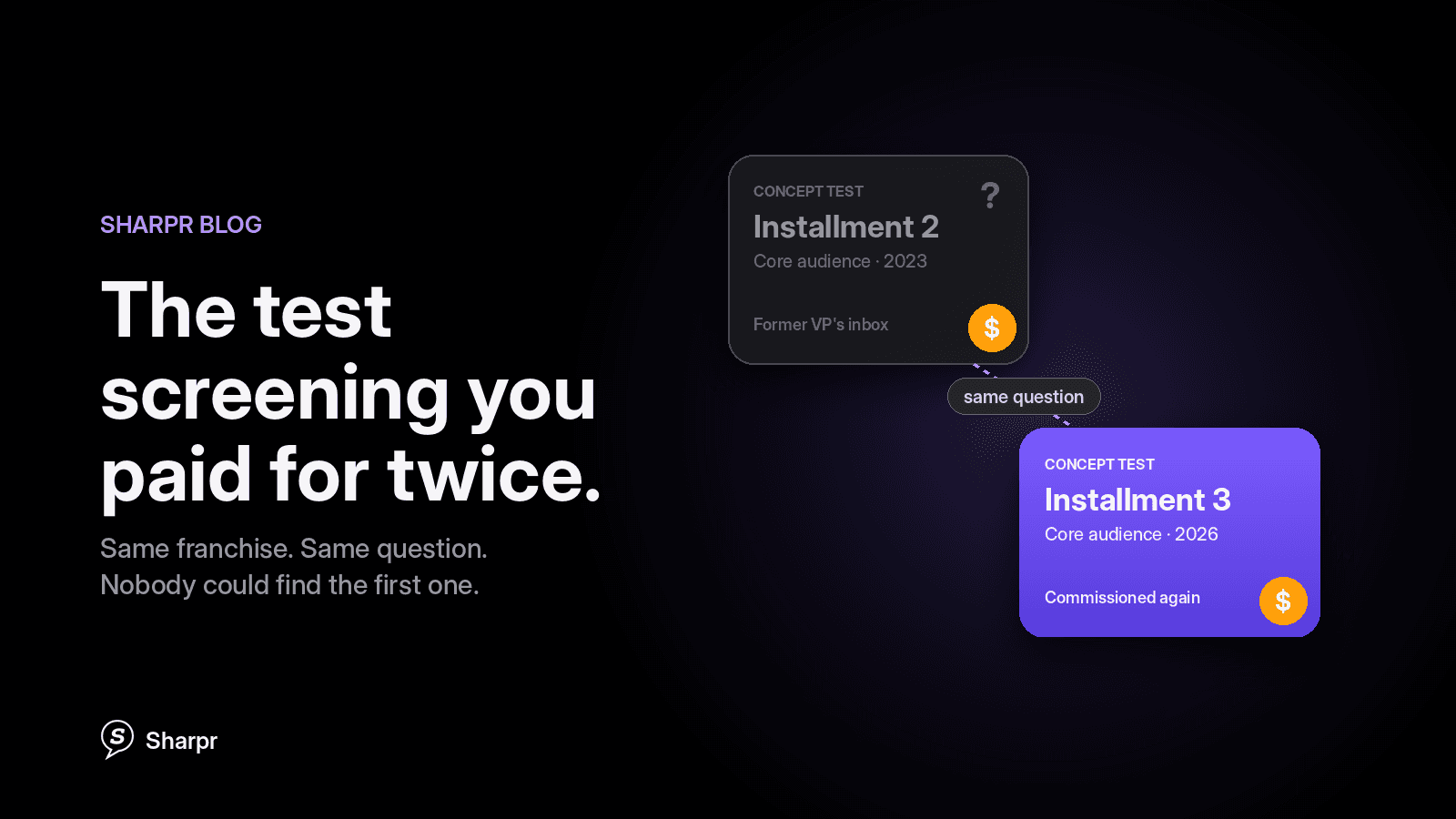
A horror franchise does well. Before the second installment, the studio runs a concept test on the core audience: who's still interested, what they want more of, what they're tired of. The study is good. It shows that the franchise's audience has aged up since the first film, that women over 25 are a bigger share than marketing assumed, and that the masked villain is the reason people come back, not the returning lead.
The findings get presented to the right room. Marketing adjusts. The movie opens fine.
Three years later the studio greenlights a third installment. There's a new head of marketing, a new research director and a new production exec on the project. Someone asks the obvious question: who is this franchise's audience now, and what do they want?
The research director searches the shared drive. Nothing obvious. The vendor portal login belonged to someone who left. The original deck is in the inbox of a former VP. So the studio briefs a new concept test.
The new study comes back and says, in different words, a lot of what the first one said. Nobody notices, because nobody has the first one to compare it to. The one genuinely useful finding, how the audience changed between installments, is the one finding nobody can see.
The studio paid twice. Worse, it paid twice and learned less than if it had paid once and kept the receipt.
Why studios are especially exposed
Every company that buys research has some version of this problem. Studios have it worse, for four reasons.
1. Franchises bring the same questions back on a schedule
The economics have shifted hard toward existing IP. One recent analysis of domestic box office from 2000 to 2025 found the share of wide releases that belong to a franchise barely moved, from about one in five to about one in four. The share of the money did not stay flat. Franchise films went from 37% of domestic gross in 2000 to 69% in 2025.
That means a growing chunk of studio revenue rides on titles where the audience questions repeat. Who's the core audience? Has it aged? Which characters carry it? What did the last trailer get wrong? Those questions get asked every installment. The answers from the last installment are the best starting point the studio has, if it can find them.
2. People turn over faster than franchises
A franchise can run a decade. Studio leadership, marketing and research teams turn over well inside that window, through promotions, restructurings, mergers and the occasional regime change. Each move takes context with it. Not just the deck, but the memory of why it was commissioned and what was decided because of it.
3. Research comes from many vendors
A single title can pull work from a tracking provider, a screening vendor, a trailer-testing shop, an exit-polling service and a streaming data provider. Each delivers in its own format, through its own portal or email. Nobody at the studio sees all of it in one place unless someone puts it there.
4. It's confidential, so it doesn't get shared
Screening results and tracking on unreleased titles are guarded. That's correct. But it also means the material ends up in the narrowest possible set of inboxes, and the more locked down it is, the less likely the next team is to know it exists.
Put those together and the repeat buy isn't a failure of discipline. It's what happens by default.
Where film test screening research goes to die
If you want to know why your team can't find past work, look at where it actually lives. Run through this list and be honest about how much is in each.
- The commissioning exec's inbox. The most common home for the final deck, and gone the day they leave.
- Vendor portals. Each provider has its own. Logins belong to individuals. Access lapses when contracts end.
- A personal drive. "I'll put it on the shared drive later."
- The shared drive, in a folder named after a project code nobody remembers.
- A chat thread. The topline numbers often live only in the messages sent the night of the screening.
- The agency's files. Trailer houses and campaign agencies sometimes hold research the studio can't easily find.
- The deal team's analysis. Licensing and valuation work often contains a better synthesis of title performance than the research team's own archive.
Notice that none of these is designed to answer a question. They're designed to store a file. That's the gap.
Not every repeat study is waste
Before going further, an honest point. Some research should be rerun.
Audiences move. The people who loved the first installment are a few years older. A concept test from before a major cultural moment may not hold after it. A screening on one cut says little about another cut. A study in one market doesn't transfer automatically to another.
So the goal isn't "never commission the same thing twice." That would be its own mistake. The goal is to decide with the old work in view.
There are three honest choices.
| Choice | When it fits | What it looks like |
|---|---|---|
| Reuse | Same audience, same question, recent enough, method still fits | Pull the study, cite it, use it in the decision |
| Refresh | Good base, but something has moved: time, audience, market, a key creative element | A smaller, cheaper study built on the old one, designed to measure the change |
| Recommission | Old work doesn't answer the question, the method doesn't fit, or too much has changed | A new study, with the old one cited as context |
Reuse, refresh or recommission: a four-point check
A quick way to make the call: score the old study on four questions, one point each.
- Does the audience definition still match?
- Is the question essentially the same?
- Is it recent enough that nothing major has changed since?
- Does the method fit the decision we're making now?
Four points: reuse. Two or three: refresh. Zero or one: recommission.
The refresh is the underused option. Most teams jump straight from "we have nothing" to "commission a full study." With the old work in hand, you can often run a narrower study that answers the new question better, because it's built to measure what changed instead of rediscovering what didn't.
Habit 1: Search by question before every brief
This is the habit that does the most work.
Before anyone writes a research brief, someone searches what already exists. Not by file name. By the question.
The questions studio teams actually ask look like this:
- What do we know about women under 25 on this franchise?
- How did our last three R-rated horror titles track against their openings?
- Which trailer approach tested best for this genre?
- Did the ending change after the second screening on the last installment, and why?
- What did exit polling say about who showed up versus who we targeted?
- How did the streaming audience differ from the theatrical audience?
If your archive can't answer questions like these, it's a storage system, not a research archive. That's fine as a starting point. But it means the search has to be done by a person who knows where things are, and that person will eventually leave.
The minimum standard: before any new brief, one person spends 30 minutes looking for prior work on the title, the franchise, the genre and the audience. They write down what they found, even if the answer is "nothing usable." That note goes in the brief.
The better standard: the archive can be searched by question, across the content of the studies, and answers point to the specific study they came from. That's the bar to aim for. It's what makes the 30 minutes become three.
Habit 2: Pull comps from your own work first
Comps drive a lot of studio decisions: greenlight, dating, spend, marketing positioning. Most comp sets get built from public box office data and outside sources. That's useful, but it's thin. It tells you how a comparable title opened. It doesn't tell you why, or who showed up, or what the audience said about it before release.
Your own research on your own past titles does.
Before a vendor or analyst builds comps from public data, pull the studio's own work on the comparable titles:
- Concept and title tests: which audiences were interested at the idea stage
- Screening results: how the movie played, by quadrant, and what got fixed
- Tracking: how awareness and interest built, and how that compared to opening
- Exit polling: who actually came, and how they rated it
- Streaming readouts: how the audience shifted after the theatrical window (more on that in Streaming data is a black box)
Line those up next to the public numbers and the comp set gets a lot sharper. Instead of "similar titles opened between X and Y," you get "similar titles opened in that range, our own testing on two of them showed the same soft spot with younger men, and both underperformed tracking in that quadrant."
That second version changes decisions. The first one mostly confirms them.
Habit 3: Write the prior evidence into the brief
Every research brief should have a section near the top called "What we already know." It's short. It does a lot.
It looks like this:
What we already know
- Concept test on Installment 2 (2023): core audience aged up versus Installment 1; women 25+ larger than planned; villain cited as the main draw.
- Exit polling on Installment 2: audience matched the concept test closely; weaker with men under 25 than tracking suggested.
- Gap: no data on how the audience has moved since 2023, and nothing on the new lead.
- Decision: refresh, not recommission. Measure change in audience composition and test reaction to the new lead.
Five lines. It stops the repeat, focuses the new study on what's actually unknown, and gives the vendor something to build on. It also gives leadership a reason to trust the research team: it shows the team knows what it owns.
If the "What we already know" section is empty, that's fine. Write "We searched [where] and found nothing usable." That's still useful, because it tells the next team where not to look.
Habit 4: Save a ten-minute record when a study closes
The single best moment to make research findable is the day it's finished. The context is fresh. The person who commissioned it still knows why.
Ten minutes. That's what it takes to save a study as a record rather than a file. Here's the minimum:
- Title and franchise
- Study type: concept, title, trailer, screening, tracking, exit, streaming readout, custom
- Vendor and fieldwork dates
- Version tested: cut ID, trailer version, title option, key art
- Audience: sample size, recruitment, quadrants or segments
- The question it was designed to answer
- Top findings, in three to five lines
- Limitations, in one or two lines
- The decision it informed, and what was decided
- Who owns it and who can access it
- Link to the full report
The two fields that get skipped most are the question and the decision. They're also the two the next team needs most. A study without its question gets misapplied. A study without its decision leaves the next team guessing whether anyone acted on it.
Make the record the last step of every study. Not done until it's saved.
Habit 5: Give the archive one owner
Shared responsibility for a research archive means no responsibility.
Pick one person. Usually a senior analyst or research ops lead: close enough to the work to know what matters, senior enough that people respond. Their job:
- Own the record template and the tags
- Check monthly that new studies are being saved
- Run the search for anyone writing a brief who asks
- Chase vendor deliverables into the archive
- Handle access when people join or leave
Two to four hours a week is usually enough once the backlog is cleared. The cost is small. The cost of one repeat study is not.
Tag for how people ask, not how you file
Most archives fail because they're organized the way the research team thinks, not the way the rest of the studio asks.
The research team thinks in vendors, project codes and fiscal years. Marketing thinks in titles and audiences. Production thinks in franchises and creative elements. Leadership thinks in genres, comps and decisions.
Tag every record with what people actually search for:
- Title, franchise, installment
- Genre and subgenre: "horror" is too broad when supernatural and slasher audiences behave differently
- Rating
- Format and window: theatrical, streaming original, post-theatrical, series
- Audience: quadrants targeted, and quadrants that actually showed up
- Creative elements tested: lead, villain, ending, title, tone
- Decision type: greenlight, cut, dating, spend, positioning
- Outcome: above, at or below expectation
Then test it. Pick five real questions from the last six months. Time how long it takes to answer each one from the archive. Anything over ten minutes means the tags are wrong or the records are missing.
The worked example, done right
Same horror franchise. Same three installments. This time with the habits in place.
Installment 2 wraps. The concept test, two screenings, tracking and exit polling are each saved as records within a week of closing. Each one has its question, findings, limitations and the decision it fed. They're tagged to the franchise, the genre, the quadrants and the creative elements tested, including "villain" and "returning lead."
Three years later, Installment 3 is greenlit. The new research director searches "what do we know about this franchise's audience." Five records come back in order. In 20 minutes she knows the audience aged up, that women over 25 were underestimated, that the villain was the draw, and that exit polling confirmed most of it.
The brief gets a "What we already know" section. It names the gap: nothing on how the audience moved since, and nothing on the new lead. The decision is a refresh, not a recommission.
The refresh is smaller and sharper. It measures change since Installment 2 and tests the new lead against the villain. It finds that the audience has aged up again, and that the new lead tests well with women over 25, which is exactly the group the franchise depends on more than marketing ever assumed.
The comp set for dating uses the studio's own exit data on Installments 1 and 2, not just public grosses. The spend plan targets the audience that actually shows up.
Same studio, same franchise, same vendors. The only difference is whether the first study survived the people who commissioned it.
Ask your vendors to help
Vendors hold more of your history than you think. Two asks at the next contract renewal:
- Deliver every report with a one-page summary that names the question, the sample, the version tested and the key limits. That page becomes your record.
- Send a list of every study they've run for you, by title, once a year.
Most will say yes. It's cheap for them, and it makes their past work easier to find, which makes it easier to buy the next study from them.
How to work out your own repeat cost
Leadership will ask what this is worth. Don't quote an industry statistic. Most of the numbers floating around come from vendors selling archive software, and they don't describe your studio.
Work it out yourself instead. It takes an afternoon.
- List every study commissioned in the last two years, with cost.
- For each one, ask: did we have prior research on the same title, franchise or audience question? Check with the people who were there.
- Sort the studies into three groups: genuinely new questions, questions where prior work existed and was used, and questions where prior work existed and wasn't used.
- Total the cost of the third group. That's your repeat spend.
- Then the harder question: for the third group, would a refresh have been enough? Estimate what that would have cost instead.
The difference is your number. It might be small. It might not be. Either way it's yours, and it will be more persuasive than any benchmark.
The two-week franchise audit
Don't try to fix the whole archive. Pick one franchise. Prove the value there.
Days 1 to 3: Inventory
List every study on the franchise across every installment: concept, title, trailer, screenings, tracking, exits, streaming readouts, custom work. Note where each one lives, who owns it and whether you can actually open it.
Days 4 to 6: Recover
Chase the missing ones. Former colleagues, vendor account leads, agency partners, the deal team. Vendors will often reissue reports they delivered if you ask.
Days 7 to 10: Record
Save each study as a record using the template above. Don't rewrite the studies. Add the question, findings, limitations, decision and tags, and link to the original.
Days 11 to 12: Test
Take five real questions about the franchise. Time how long it takes to answer each from the records.
Days 13 to 14: Show it
Put the franchise timeline in front of the next brief or the next greenlight conversation. Every installment, every study, in order, with what each one said.
That timeline is usually the moment the room gets it. Seeing ten years of audience evidence on one page, often for the first time, tends to end the debate about whether this is worth doing.
Mistakes that keep the repeat buy alive
Treating the archive as an IT project. It's a research practice. The software matters less than the habit of saving records and searching first.
Filing by vendor or fiscal year. Nobody outside the research team searches that way.
Saving the deck, not the context. A deck without its question and decision is a future argument.
Only saving the hits. The studies on titles that underperformed teach more. Save them all.
Keeping the deal team's work separate. Licensing and valuation analyses describe the same titles. If they live in a different system, half the picture is missing.
Locking everything so tight nobody knows it exists. Confidential doesn't have to mean invisible. A record can say a study exists and who owns it, with access controlled, without exposing the contents to everyone.
Waiting for a perfect system. Start with one franchise and a template. Improve from there.
The point
Studio research is expensive, slow to set up and often impossible to repeat under the same conditions. The audience that saw the first screening of Installment 2 will never see it fresh again. That study is a one-time asset.
Most studios treat it like a one-time deliverable instead: present it, file it, forget it, and pay for something similar three years later.
The fix isn't glamorous. Search before you brief. Use your own comps. Write down what you already know. Save a record when a study closes. Give the archive an owner.
Do that, and the most valuable research a studio owns stops walking out the door with the people who commissioned it.
Sharpr makes every screening, test and tracking study searchable by question, with answers that cite the source.
Want the study record template and the two-week franchise audit as a checklist? Email Joey at joey.stawiarski@sharpr.com.
Frequently asked questions
What is film test screening research?
Film test screening research is the audience research a studio runs by showing a cut of a movie to a recruited audience before release, then surveying them and often holding a focus group. Results are usually broken out by quadrant and feed decisions on edits, marketing and dating. It sits alongside concept, title and trailer tests, tracking and exit polling, and all of it is at risk of being bought twice.
Why do studios pay for the same research twice?
Because past studies live in places built to store files, not answer questions: a former exec's inbox, a lapsed vendor portal, a personal drive. Franchises bring the same audience questions back every installment, and the team asking is rarely the team that asked last time, so the old study is never found.
When should a studio rerun a test screening or concept test?
Score the old study on four questions: does the audience definition still match, is the question the same, is it recent enough that nothing major has changed, and does the method fit the current decision. Four points means reuse it, two or three means run a smaller refresh study that measures the change, and zero or one means recommission.
What should a research study record include?
Title and franchise, study type, vendor and fieldwork dates, version tested, audience and sample, the question it was designed to answer, three to five top findings, limitations, the decision it informed, the owner and access rules, and a link to the full report. The question and the decision are the two fields teams skip most and need most.
How can a studio stop re-buying research it already owns?
Search prior work by question before every brief, build comps from your own studies first, add a "What we already know" section to every brief, save a ten-minute record when each study closes, and give the archive one owner. To start, run a two-week audit on a single franchise.